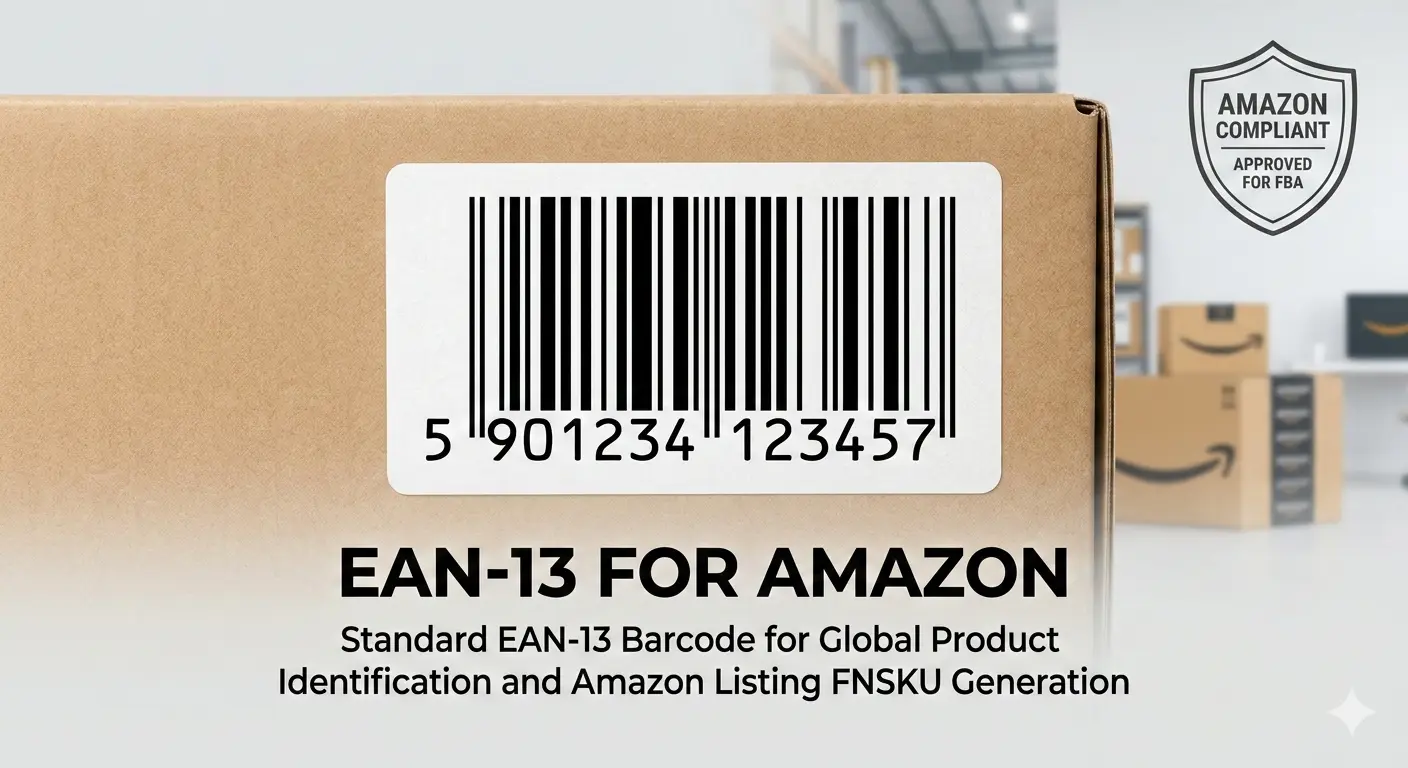
EAN-13 for Amazon: GTIN Ownership, Catalog Matching & FBA Guide
A marketplace implementation guide covering GTIN/EAN identity, ASIN distinction, product variants, bundles, catalog matching, GTIN exemptions, barcode print quality, and fulfillment-label boundaries.
1. GTIN, EAN and ASIN Are Different Things
| Term | System | Purpose |
|---|---|---|
| GTIN / EAN | Global product identification | Identifies trade item. |
| ASIN | Amazon | Identifies Amazon catalog record. |
| Seller SKU | Seller | Internal offer/inventory reference. |
| Fulfillment label | Amazon workflow | Operational warehouse handling. |
2. Start With Legitimate Product Identity
Amazon's current seller guidance describes GTINs as product IDs used to match or create listings. A scannable EAN-13 image does not make an invented number a legitimate product identifier.
If you already have a valid EAN-13 number, you can create the barcode image with our free online EAN-13 barcode generator and export it as PNG, JPG, or SVG.
3. Catalog Matching Before New Listing
If a product already exists in Amazon's catalog, the seller generally matches an offer to the existing product detail page rather than creating a duplicate identity. Product-ID workflow should therefore start with catalog search/matching.
4. Variants and Pack Configurations
Size, color, count, bundle composition and multipack configuration can affect trade-item identity. Resolve the exact sellable configuration before assigning/using a GTIN.
Common error
Do not reuse a single-unit GTIN for a different multipack simply because the underlying product is the same.
5. GTIN Validation Problems
| Symptom | Possible Cause | Check |
|---|---|---|
| Product ID rejected | Unrecognized/invalid GTIN | Assignment and exact digits. |
| Brand mismatch | Identity conflict | Brand owner/product relationship. |
| Existing product found | Catalog match | Add offer rather than duplicate. |
| Check-digit error | Typing/import | Recalculate/compare source. |
6. GTIN Exemption Boundary
Amazon states that some products may be eligible for a GTIN exemption. Eligibility and workflow can vary by category/brand, so exemption is a marketplace process—not a reason to fabricate a barcode number.
7. FBA Operational Labels
Catalog product identity and fulfillment labeling are separate layers. Follow the current Seller Central fulfillment workflow for the inventory-label requirements that apply to the shipment/product.
8. Consumer Barcode Print Quality
If the manufacturer's EAN/UPC remains on packaging, it still needs normal barcode engineering: correct value, dimensions, quiet zones, contrast and placement.
9. Troubleshooting by Layer
Diagnose the layer that failed instead of regenerating barcodes whenever Amazon displays an error.
10. Data Management
Maintain a product-ID register containing GTIN, exact product/variant, brand, packaging level and Amazon catalog mapping. This prevents accidental reuse when the catalog grows.
11. Pre-Listing Checklist
Confirm the exact product configuration, legitimate GTIN where required, valid check digit, catalog search result, brand/variant data and current marketplace requirements before creating the listing.
12. Catalog Identity vs Offer Identity
Amazon's catalog record describes the product, while seller-specific offer data includes price, condition, inventory and seller SKU. A GTIN belongs to the product-identification layer; changing the seller SKU does not create a new product identity.
13. When Packaging Changes
A packaging redesign does not automatically require a new GTIN, but changes to product quantity, formulation, dimensions, brand ownership or how the trade item is ordered may affect identification rules. Review the trade-item change rather than assuming the old number always remains valid.
14. Evidence and Seller Support
When a marketplace questions product identity, keep invoices, brand records, GS1 evidence and packaging images organized. Troubleshooting is faster when identifier ownership and the exact physical product can be demonstrated consistently.
15. Bundles and Multipacks
Bundles and multipacks require careful product-identity analysis. A two-pack sold as one trade item is not simply two independent units placed together for shipping. Catalog attributes, GTIN assignment and packaging need to describe the exact customer-facing configuration. Reusing a component GTIN for the bundle can cause listing conflicts, receiving errors or incorrect product matching.
16. Marketplace Rules Change Independently of Barcode Standards
EAN-13 technical rules are relatively stable, but Amazon listing and fulfillment requirements can change by marketplace, category and program. Keep marketplace-specific workflow guidance separate from the permanent barcode reference content so operational instructions can be updated without rewriting the underlying EAN/GTIN explanation.
17. Amazon Catalog Troubleshooting Workflow
When Amazon rejects a product identifier, changing the barcode image should not be the first response. Start by identifying which layer reported the problem. A check-digit error is a numerical validation issue; a brand mismatch is a catalog-identity issue; an existing ASIN match is a catalog-deduplication issue; and an FBA labeling message belongs to the fulfillment layer. Treating all of these as 'barcode problems' leads to unnecessary GTIN changes and duplicate listings.
A disciplined seller keeps an evidence set for each product: the assigned GTIN, brand ownership or authorization information, packaging photographs, exact variant attributes, bundle or multipack composition, and the Amazon catalog relationship. When support requests clarification, this evidence makes it easier to show that the GTIN belongs to the actual trade item rather than merely presenting a barcode image generated from the number.
Before changing an identifier, verify whether the product itself changed. If only the listing title, image, price, seller SKU, or fulfillment method changed, a new GTIN is generally not created merely for that operational change. Product identity and marketplace operations should remain separate. That discipline prevents fragmented catalogs, broken reviews, inventory mismatches, and packaging that carries a number no longer aligned with the product master.
Related Guides
Continue with closely related technical references.