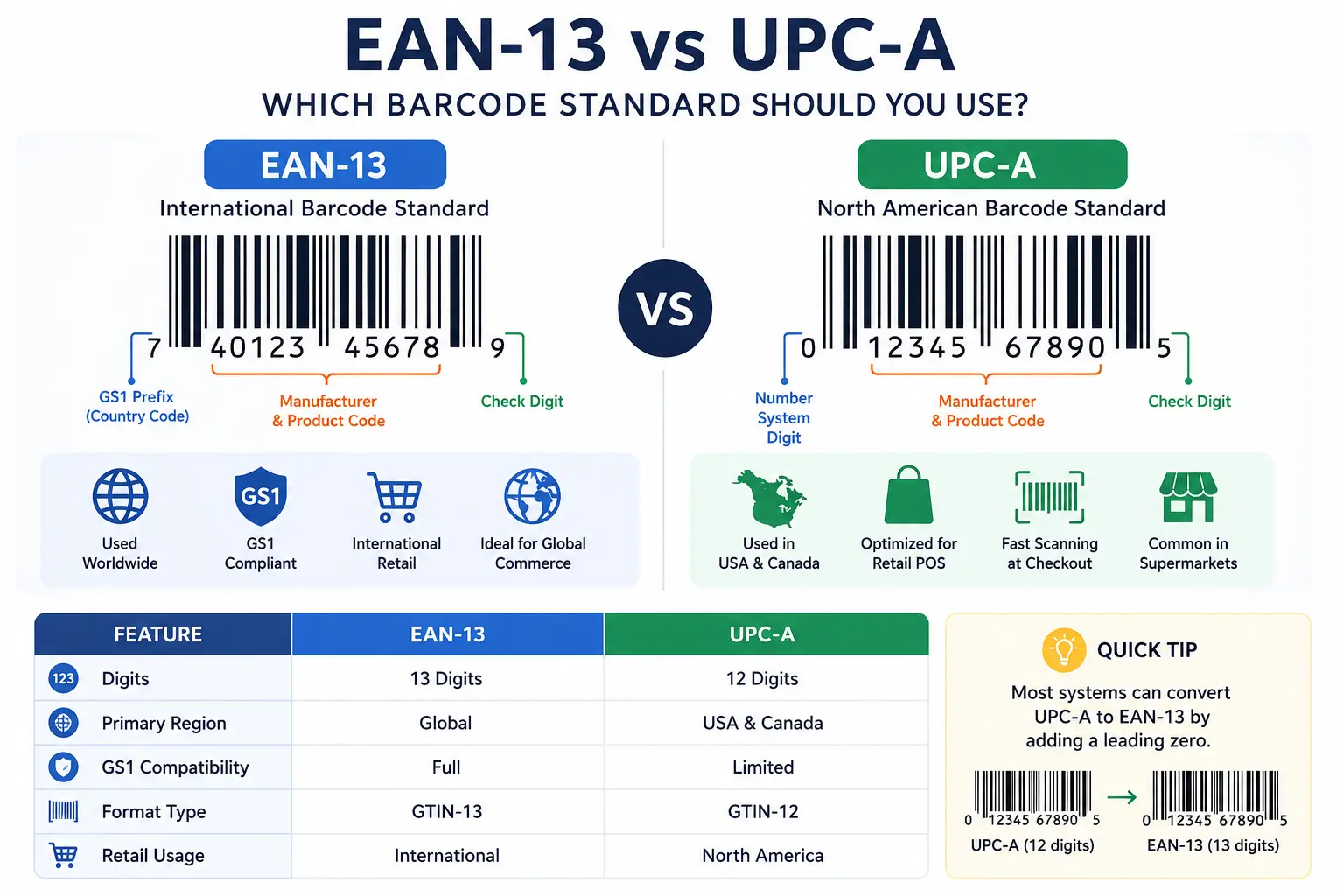
EAN-13 vs UPC-A: GTIN-13 vs GTIN-12 Technical Comparison
A detailed comparison of EAN-13 and UPC-A covering identifier length, symbol encoding, leading-digit parity, Modulo-10 checks, leading-zero representation, scanner interoperability, retail markets, databases, and migration mistakes.
1. The Main Difference
EAN-13 carries GTIN-13; UPC-A carries GTIN-12. Both belong to the same retail barcode family and share many scanning concepts, but the identifiers are not interchangeable by arbitrary digit deletion or insertion.
2. Side-by-Side
| Feature | EAN-13 | UPC-A |
|---|---|---|
| Digits | 13 | 12 |
| Identifier | GTIN-13 | GTIN-12 |
| Check digit | GS1 Modulo-10 | GS1 Modulo-10 |
| Retail POS | Yes | Yes |
| Historical footprint | International | U.S./Canada |
To create EAN-13 or UPC-A barcode images, use our online barcode generator and download the result as PNG, JPG, or SVG.
3. EAN-13 Leading-Digit Parity
EAN-13 represents its first digit indirectly: that digit selects the L/G parity pattern for the next six digits on the left side. UPC-A does not use the same leading-digit parity mechanism.
4. Shared Guard Structure
Both use start, centre and end guard patterns with left/right data regions and quiet zones. Their close optical relationship supports broad scanner interoperability.
5. Check-Digit Logic
Both use the GS1 Modulo-10 method, but EAN-13 calculates from twelve preceding digits while UPC-A calculates from eleven.
6. Leading-Zero Representation
A GTIN-12 can be represented in a wider GTIN data field by left-padding with zeroes according to system rules. That representation does not create a new product identifier.
Database rule
Store GTINs in a format that preserves leading zeroes and original identity.
7. Can EAN-13 Be Converted to UPC-A?
Do not remove the first digit from an arbitrary EAN-13 and call the result UPC-A. Use the GTIN actually assigned to the trade item and the carrier appropriate for that identifier/workflow.
8. Scanner Compatibility vs Catalog Compatibility
A scanner may decode both formats, yet a retailer or marketplace can still reject the product ID because business/catalog rules are separate from optical decoding.
9. Packaging and Printing
| Issue | Both Formats |
|---|---|
| Quiet zones | Required clear areas. |
| Proportional scaling | Required. |
| Contrast | Critical. |
| Final-substrate testing | Required for reliable production. |
| Leading zero handling | Software must preserve identity. |
10. Market Selection
Choose based on the assigned GTIN and trading-partner requirements, not the assumption that one format is universally better or more modern.
11. Common Mistakes
| Mistake | Why Wrong |
|---|---|
| Truncate EAN-13 | Changes identity. |
| Invent leading zero | May misrepresent identifier. |
| Assume successful scan proves ownership | Only proves decoding. |
| Use numeric DB field | Can drop zeroes. |
12. Decision Checklist
Identify the assigned GTIN, confirm retailer/marketplace requirements, validate the check digit, preserve the exact data in software, generate the correct symbology and verify final print quality.
13. Why the Symbols Look So Similar
UPC-A and EAN-13 were designed for interoperable retail scanning and share the same basic module width and guard-pattern concepts. EAN-13 extends the numbering capacity through parity encoding of the leading digit rather than simply making the symbol one digit wider.
14. Data Exchange Normalization
Retail databases often normalize GTINs into a fixed-length field such as 14 digits. That normalization is useful for comparison and storage, but user interfaces should still present the identifier appropriately for the carrier and market context.
15. International Distribution Planning
When a brand expands across markets, avoid creating duplicate identities merely because one region historically used UPC-A and another commonly uses EAN-13. Start from the assigned GTIN and trading-partner requirements.
16. Scanner Output Configuration
Some scanners can be configured to transmit UPC-A as a 13-digit EAN-style value with a leading zero, while others transmit the original 12 digits. Applications should standardize this behavior or normalize input explicitly; otherwise identical products can appear under different string lengths in logs and databases.
17. Reporting and Analytics
Analytics systems should normalize GTIN representations consistently before joining sales, inventory and marketplace data. If one source stores UPC-A as 12 digits and another pads it to 14, naive string comparison can create duplicate products. Preserve the source value, but use a documented canonical representation for cross-system matching.
18. Cross-System Normalization Scenario
Consider a manufacturer that sells the same product through a North American retailer, a European distributor, and an e-commerce marketplace. The underlying product identity should remain stable, but each downstream system may store or display the GTIN differently. One database may retain the original 12-digit GTIN-12, another may normalize every GTIN into a 14-digit field, and a reporting warehouse may import the printed carrier value exactly as scanned. Without a normalization policy, the same trade item can appear as multiple products simply because of leading-zero representation.
A sound integration keeps two fields: the original authoritative identifier and a canonical comparison form. The canonical form can be used for joins, deduplication, and cross-system reconciliation, while the source representation remains available for audit and carrier-specific display. Scanner configuration must be documented too, because some devices can transmit a UPC-A value with a leading zero when configured for EAN output.
The practical lesson is that EAN-13 versus UPC-A is not only a printing question. It is also a data-integration question. When systems exchange product identifiers, define accepted lengths, padding rules, check-digit validation, and how the original value is preserved. That prevents false duplicates and avoids the dangerous practice of manually editing digits to make one system accept another system's format.
Related Guides
Continue with closely related technical references.