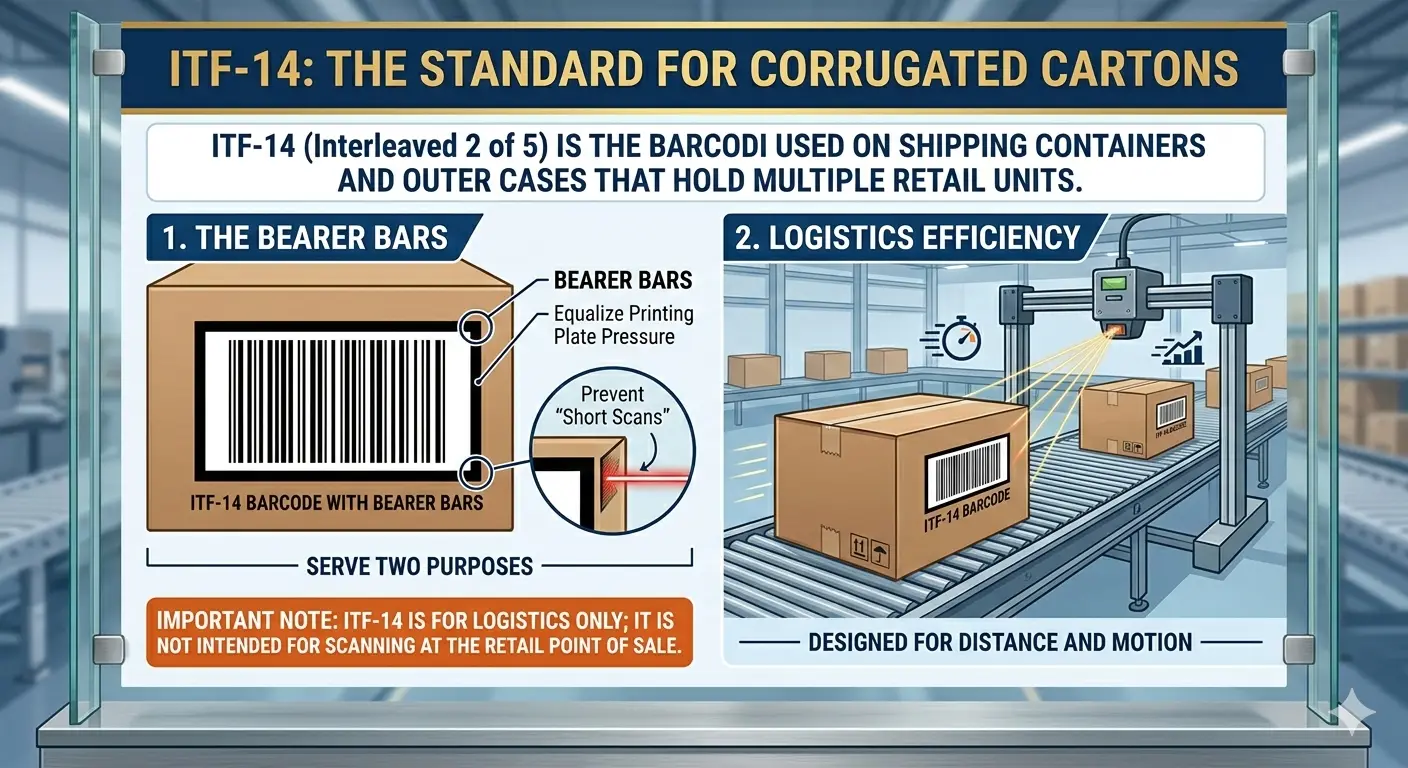
ITF-14 barcode for logistics
Distribution Barcode Standard

ITF-14 Barcode: GTIN-14, Bearer Bars & Corrugated Printing Guide

A logistics-focused reference for ITF-14 covering GTIN packaging levels, Interleaved 2 of 5 mechanics, bearer bars, wide/narrow ratios, corrugated printing, check digits, case identification, placement, and verification.

Carrier
ITF-14
GTIN Capacity
Up to 14 Digits
Best Fit
Cases / Corrugated

1. Role of ITF-14 in Distribution

ITF-14 is a GS1 barcode used for trade-item groupings and is especially useful when printing conditions are less precise, such as direct printing on corrugated fibreboard. It carries a GTIN and does not carry GS1 attribute data such as lot or expiry.

2. GTIN Packaging-Level Logic

A case, carton or grouping can be a distinct trade-item level from the consumer unit. The identifier must describe the actual packaging configuration used in logistics.

Layer Example Question
Consumer unit What does the shopper buy?
Inner pack Is this a separately managed trade item?
Case How many units and what configuration does this GTIN identify?

3. Interleaved 2 of 5 Mechanics

ITF encodes digits in pairs. One digit controls a five-element bar pattern while the paired digit controls a five-element space pattern; the two patterns are interleaved. This makes ITF numeric-only and naturally suited to even-length encoded data.

4. Bearer Bars

ITF-14 uses prominent bearer bars around the symbol. They support reliable scanning and help expose/limit certain printing and partial-scan problems on difficult packaging.

Not decoration

Bearer bars are functional parts of the ITF-14 symbol and should not be removed to make the artwork look cleaner.

5. GTIN Check Digit

The GTIN carried by ITF-14 uses the GS1 Modulo-10 check digit. Validate the identifier before generating the symbol; optical correctness cannot repair an incorrectly assigned packaging-level GTIN.

6. Corrugated Printing Engineering

Issue Why Corrugated Is Difficult Mitigation
Rough fibres Edges become irregular Use appropriate X-dimension.
Ink spread Narrow spaces close Control plates/ink/process.
Panel flex Geometry changes Choose stable panel.
Print pressure Bar width changes Verify production output.

7. Wide/Narrow Ratio and X-Dimension

Interleaved 2 of 5 depends on clear distinction between wide and narrow elements. Direct-print processes must preserve that relationship despite substrate texture and ink gain.

8. Placement on Cases

Avoid panel edges, folds, seams, straps and areas likely to be crushed. Placement should reflect how cartons travel on conveyors and how warehouse operators or fixed scanners encounter them.

9. ITF-14 vs GS1-128

Requirement ITF-14 GS1-128
Carry GTIN Yes Yes
Carry lot/expiry/serial No Yes via AIs
Corrugated tolerance Strong use case Requires suitable print quality
Data richness Low High

10. Verification in the Warehouse

Case PrintedSample VerificationConveyor / Hand ScanGTIN LookupReceiving / Shipping

A symbol should be tested both as a printed object and as part of the actual receiving/shipping workflow.

11. Failure Diagnosis

Symptom Likely Cause Action
Intermittent reads Print spread/placement Inspect physical symbol.
Correct scan, wrong case GTIN mapping Audit packaging-level master data.
Need lot data Carrier limitation Evaluate GS1-128/2D option.
Damaged edges Case handling Move/protect symbol location.

12. Case-Label Release Controls

Confirm packaging-level identity, check digit, bearer bars, wide/narrow geometry, quiet zones, panel placement, corrugated print quality and real warehouse scans.

13. Indicator Digit and Case Configurations

GTIN-14 can be used to identify different packaging configurations of the same underlying trade item. The leading indicator digit participates in that packaging-level structure, but it should not be manipulated casually. Packaging configurations and their identifiers belong in controlled master data.

14. Direct Printing vs Applied Labels

ITF-14 is often associated with direct printing on corrugated cases because its wide/narrow design tolerates less precise printing than many other retail symbols. If a high-quality applied label is used instead, other GS1 carriers may also be suitable depending on the required data and trading-partner rules.

15. Bearer-Bar Production Effects

Bearer bars also expose plate-pressure and print-gain problems during direct printing. If bearer bars appear uneven, broken, or excessively heavy, the underlying printing process may need correction before the barcode itself can be trusted.

16. Case Quantity and Master-Data Accuracy

The value of ITF-14 depends on the receiving system knowing exactly what the GTIN-14 represents. If a case identifier is configured for 12 consumer units but the physical case changes to 10, warehouse automation can produce systematic receiving and replenishment errors even though every barcode scans perfectly. Packaging quantity therefore belongs in controlled trade-item master data and should be reviewed whenever case configuration changes.

17. Conveyor Orientation and Presentation

Case labels should be positioned for the way cartons actually travel through conveyors and sortation equipment. A symbol hidden by stretch wrap overlap, rotated into an inaccessible face, or placed too close to a crushed edge can reduce automated read rates. Site testing should include realistic carton orientation, conveyor speed and scanner tunnel geometry instead of only hand-scanning stationary cartons.

18. Case-Level Master Data and Receiving

ITF-14 becomes operationally valuable when the warehouse product master knows what one scanned case represents. Store the case GTIN, contained consumer GTIN, quantity, unit of measure, dimensions, and active dates. Receiving software can then translate one case scan into the correct inventory quantity without relying on operators to enter counts manually.

If the case quantity changes, review the identifier before shipping the new configuration. Reusing an old case GTIN for a different count creates a systematic error: every receiving scan can book the wrong quantity while the barcode continues to decode perfectly. This is a data-governance failure, not a print failure.

Test receiving with realistic cases, including mixed pallet positions, stretch wrap, conveyor movement, and label wear. The goal is not only to prove ITF-14 readability but to verify that the scan triggers the correct case-level transaction and quantity in the WMS or trading-partner system.

2026 Copyright © Qrivio Barcode | All rights reserved.