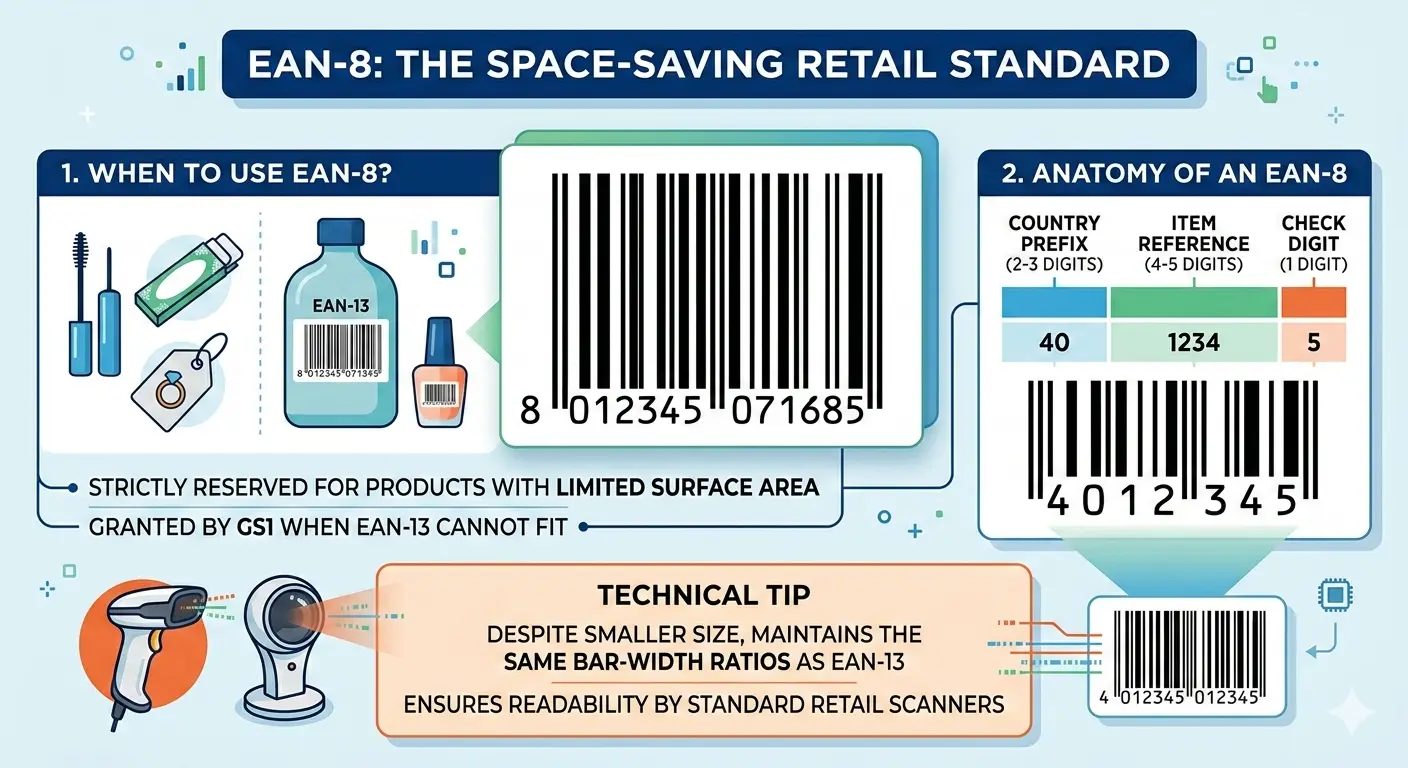
EAN-8 Barcode: GTIN-8 Small-Package Technical Guide
A focused reference for GTIN-8 allocation, EAN-8 symbol structure, Modulo-10 validation, compact-package engineering, POS scanning, print tolerances, and deployment decisions.
1. Why EAN-8 Exists
EAN-8 provides a compact EAN/UPC-family carrier for legitimately assigned GTIN-8 identifiers. It is intended for situations where packaging constraints make larger retail symbols impractical. It is not created by deleting digits from an EAN-13.
Critical rule
A shorter picture is not a reason to invent a shorter identifier. GTIN-8 allocation and eligibility come first.
2. Eight-Digit Data Model
| Position Group | Role | Rule |
|---|---|---|
| Digits 1–7 | Assigned GTIN data | Preserve exact digits, including zeroes. |
| Digit 8 | Check digit | GS1 Modulo-10 result. |
Unlike informal SKU numbering, GTIN-8 is a standardized trade-item identity. The application should keep it as text rather than converting it to an integer.
3. EAN-8 Symbol Layout
The shorter symbol reduces width relative to EAN-13, but it still requires proper guard patterns, bar height, clear margins and controlled printing.
4. Check-Digit Validation
The final digit uses the GS1 Modulo-10 method. Validation should happen before rendering and again when imported data is received from spreadsheets, ERP exports or suppliers.
Software rule
Do not silently repair an invalid GTIN by replacing its check digit unless the source-of-truth process explicitly authorizes that change.
5. Small-Package Geometry
Compact packaging often introduces multiple risks at once: limited flat area, curvature, seams, transparent film and dense artwork. The available rectangle must include the symbol body and quiet zones, not just the visible bars.
| Constraint | Typical Failure | Response |
|---|---|---|
| Narrow panel | Quiet zone cropped | Reserve barcode footprint early. |
| Bottle curvature | Edge distortion | Move to flatter region. |
| Tiny label | Modules become too narrow | Use compliant sizing, not arbitrary shrinking. |
| Flexible film | Wrinkles | Choose stable print/label area. |
6. Printing on Difficult Materials
| Material | Risk | QA |
|---|---|---|
| Glossy carton | Glare | Scan at multiple angles. |
| Transparent film | Variable background | Use opaque backing. |
| Thermal label | Bar growth | Tune printer settings. |
| Rough stock | Voids | Inspect edges and contrast. |
7. POS and Database Behavior
EAN-8 does not make a product record smaller or simpler; it only provides a more compact optical carrier for the assigned identifier.
8. EAN-8 vs EAN-13
| Decision | EAN-8 | EAN-13 |
|---|---|---|
| Identifier | GTIN-8 | GTIN-13 |
| Package need | Space constrained | General retail |
| Can one be truncated into the other? | No | No |
| POS family | EAN/UPC | EAN/UPC |
9. Common Implementation Errors
| Error | Impact | Correction |
|---|---|---|
| Truncating EAN-13 | Different/invalid identity | Use assigned GTIN-8. |
| Removing quiet zones | Poor acquisition | Keep clear margins. |
| Storing as number | Leading zero loss | Use string type. |
| Testing only on monitor | Misses print defects | Test final pack. |
10. EAN-8 Production Acceptance
Before release, confirm the GTIN-8 source, check digit, exact encoded value, physical dimensions, quiet zones, substrate, placement and scans with representative POS hardware.
11. GTIN-8 Allocation as a Business Decision
GTIN-8 is scarce compared with ordinary company-prefix-based item numbering, which is one reason small-package eligibility is handled separately. The correct workflow is to assess physical package constraints, confirm eligibility with the relevant GS1 organization, and only then incorporate the assigned identifier into production artwork.
12. Quiet-Zone Pressure on Tiny Packs
On very small packs, the most common design mistake is budgeting only for the visible bars. The required clear areas are part of the functional barcode footprint. If a designer trims these margins to make the symbol fit, the result can become unreliable even though every bar remains present.
13. Small-Pack POS Testing Strategy
Testing should include the finished pack at multiple orientations and realistic checkout distances. Small symbols are more sensitive to print growth, curvature, glare, and scanner focus. A proof on plain office paper is not representative of a tiny glossy consumer package.
14. Eligibility Should Be Resolved Before Artwork
EAN-8 is often requested too late, after packaging design has already consumed most of the printable area. That reverses the correct order. First establish the product identifier and applicable GS1 path, then reserve compliant barcode space in the artwork. If the product does not qualify for GTIN-8, the design should be adjusted to accommodate the correct retail carrier instead of compressing or inventing a smaller symbol.
15. Small Symbol Verification
Because EAN-8 is used on space-constrained packages, production verification is especially valuable. A symbol can be nominally valid yet sit so close to the printer's resolution or ink-spread limits that performance becomes unstable. Test multiple production samples, not a single ideal print, and include samples from the edges of tolerances such as darker/lighter printing and slightly different package curvature.
16. Designing Around the Complete EAN-8 Footprint
A product designer should treat EAN-8 as a protected rectangle, not just a group of bars. The protected area includes the complete symbol, human-readable text where required, and the clear margins needed for acquisition. This footprint should be placed into the dieline before surrounding graphics are finalized.
On cylindrical or flexible products, orientation matters. Bars spanning a severe curve can produce different apparent widths across the scanner's field of view. When a flat panel is unavailable, test alternative orientations and placements using the exact container, label material, and printing method. Small-package barcode design is a mechanical problem as much as a graphic one.
The final acceptance sample should come from production equipment, not a laser-printer mockup. Measure the physical symbol, inspect the clear zones, confirm the encoded GTIN-8, and scan several samples. If the print process has meaningful variation, verification across multiple samples is more informative than approving one unusually perfect label.
Related Guides
Continue with closely related technical references.